

Shop this story














Why High Bloom’s Verbs Don’t Automatically Guarantee High DOK in Classrooms
💡 Beyond the Buzzwords: Why High Bloom’s Verbs Don’t Automatically Guarantee High DOK in Classrooms
Think you’re designing challenging assessments just by using impressive words like “Analyze” or “Evaluate”? Think again!
In the bustling world of education, frameworks like Bloom’s Taxonomy and Webb’s Depth of Knowledge (DOK) are invaluable tools. They help educators categorize the cognitive demands placed on students. However, a common and significant misconception often trips up even the most well-meaning Social Studies teacher: the belief that a “higher Bloom’s level always equals a higher DOK level.”
This assumption is not only incorrect but can also lead to assessments that appear rigorous but fail to genuinely challenge students’ thinking or measure their capacity for critical problem-solving—a core goal of the Ghanaian curriculum.
🧠 Bloom’s vs. DOK: The Critical Difference
Before designing instruction or assessment, we must clarify what each framework truly measures:
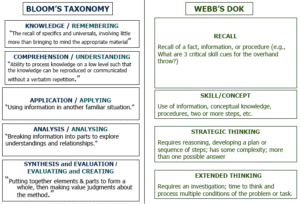
Bloom’s Taxonomy (Revised): The Cognitive Process
Bloom’s focuses on the type of cognitive process a student uses. It defines the action being taken. Think of the verbs in your learning objectives: Remember, Understand, Apply, Analyze, Evaluate, Create (Krathwohl, 2002).
Webb’s Depth of Knowledge (DOK): The Cognitive Context
DOK focuses on the complexity of the content and context required to complete a task. It’s less about what the student is doing (the verb) and more about how deeply they have to think to execute the task (Webb, 1997). DOK levels range from 1 (Recall) to 4 (Extended Thinking).
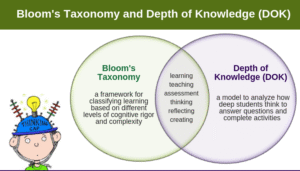
The critical insight, often missed in curriculum planning, is that a high-level Bloom’s verb, like “Analyze” or “Evaluate,” can be associated with a lower DOK level if the task is routine or only requires a shallow look at the content. Conversely, a seemingly lower-level Bloom’s verb, like “Describe,” can be DOK 3 if the description requires complex reasoning and synthesis of multiple, conflicting sources.
🌍 Social Studies: Where Rigor is Defined by DOK
The divergence between Bloom’s and DOK is most evident in complex subjects like Social Studies, where the goal is to develop application and critical judgment, not just memorization.
Example 1: The Power of “Analyze”
A Bloom’s level of Analyze means breaking down information into component parts.
-
DOK 2 (Skill/Concept) Task: Analyze the immediate causes of the 1948 Accra Riots based on a provided, single-page newspaper excerpt.
-
Why DOK 2? The task is routine. The information needed is readily available (single excerpt), and the criteria for analysis are simple (immediate causes). It requires basic conceptual application, but not deep strategic thinking.
-
-
DOK 3 (Strategic Thinking) Task: Analyze the long-term political and economic connections between the cocoa price crash of the 1960s and the subsequent military coups in Ghana, justifying why these two factors are intrinsically linked.
-
Why DOK 3? This requires strategic thinking. Students must draw on knowledge from multiple concepts (economics, political science, history), make connections across different time periods, and formulate a complex, non-obvious argument supported by evidence. This is non-routine and requires planning and reasoning.
-
Example 2: The Nuance of “Evaluate”
A Bloom’s level of Evaluate means making judgments based on criteria and standards.
-
DOK 2 (Skill/Concept) Task: Evaluate whether the decision to build the Akosombo Dam was successful, using only the criteria given in the textbook (e.g., power generation and industrial growth).
-
Why DOK 2? The task is routine. The criteria for judgment are provided and clearly defined. The student mainly has to match facts to the given criteria, which is a fairly routine application of a skill taught in class.
-
-
DOK 4 (Extended Thinking) Task: Evaluate the long-term sustainability and ethical implications of the Akosombo Dam project, considering social displacement, environmental impact, and economic debt on Ghana today, and propose an alternative development strategy.
-
Why DOK 4? This is extended, non-routine, and complex thinking. It requires drawing information from various fields (history, geography, ethics), developing a multi-faceted argument based on self-selected criteria, and then generating a new solution – true creative problem-solving over an extended period.
-
Implications for Assessment Design in Ghanaian Classrooms
Understanding this crucial distinction between Bloom’s and DOK is vital for designing effective and meaningful assessments that foster the critical thinking, creativity, and problem-solving skills necessary for national development.
1. Shift Focus from Verb to Context (The Depth)
The most significant problem is that teachers rely solely on Bloom’s verbs, mistakenly believing that using “Analyze” automatically guarantees a rigorous assessment. This often leads to questions that look high-level but are low DOK because the answer has already been discussed and is readily recalled.
The solution is to focus on the complexity of the task itself. Does the student merely recall or match information, or must they synthesize knowledge from different lessons, justify their reasoning, and solve a non-routine problem?
2. Prioritize DOK 3 & 4 for HOT Skills
While DOK 1 and DOK 2 items are essential to measure foundational knowledge of Ghanaian history, civics, and geography, a deliberate inclusion of DOK 3 (Strategic Thinking) and DOK 4 (Extended Thinking) tasks is crucial to truly measure Higher-Order Thinking (HOT) skills.
-
DOK 3 Task Example: Compare and contrast the democratic systems of Ghana and a neighboring ECOWAS country (e.g., Nigeria), and justify which system is more effective at managing ethnic diversity. (This requires non-routine reasoning and evidence).
-
DOK 4 Task Example: Working in a group, develop a comprehensive proposal for the local government on how to sustainably manage the effects of galamsey (illegal mining) in a specific community, including a fully argued defense of the policy’s economic viability. (This demands research, planning, multi-step analysis, and creating a new product or solution).
3. Align with Real-World Competencies and Development
Assessment tasks should move beyond theoretical knowledge to reflect the practical application of Social Studies knowledge to real-world Ghanaian issues (Dufour et al., 2006). High-DOK tasks naturally lend themselves to project-based assignments, ethical debates, and community-focused research that mirror the complexities of national development challenges. This shifts the focus from simple fact memorization to informed, active citizenship.
By understanding that a “high Bloom’s verb” does not automatically equate to a “high DOK task,” we empower ourselves to design more effective assessments that genuinely push our Ghanaian students to think deeper, critically analyze challenges, and creatively contribute to their communities and nation.
References
-
Dufour, R., DuFour, R., Eaker, R., & Karhanek, G. (2006). Whatever it takes: How professional learning communities respond to diverse student needs. Solution Tree.
-
Krathwohl, D. R. (2002). A revision of Bloom’s taxonomy: An overview. Theory into Practice, 41(4), 212–218.
-
Webb, N. L. (1997). Criteria for alignment of expectations and assessments in mathematics and science education. Council of Chief State School Officers.
Further reading


World-Class, 100% Fully Funded PhD Scholarships

Leave a comment