


Shop this story


















Why Webb’s Depth of Knowledge (DOK) is Key to Quality Social Studies Assessment
🧠 Beyond Difficulty: Why Webb’s Depth of Knowledge (DOK) is Key to Quality Social Studies Assessment
In education, we often mistake a difficult question for a complex one. A difficult question might require obscure factual recall, but a complex question demands deep, strategic thinking. For Social Studies teachers looking to genuinely measure skills like critical thinking, analysis, and civic literacy, Webb’s Depth of Knowledge (DOK) framework is the essential tool.
DOK analyzes the cognitive complexity or depth of understanding required to complete an academic task, regardless of how easy or difficult the action verb might seem. It shifts the focus away from the verb itself (e.g., analyze) and onto the complexity of the content and context in which the task is performed.
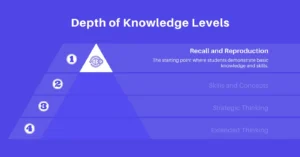
🧐 The Four Levels of Cognitive Rigor (DOK)
The four DOK levels represent a clear, increasing progression in intellectual rigor, moving from simple memorization to complex, long-term creation.
DOK 1: Recall and Reproduction
This is the foundational level. Tasks require students to retrieve basic information, facts, definitions, or simple procedures. The task is straightforward, typically involves a single step, and requires no deep analysis or conceptual understanding.
-
Social Studies Example: A student is asked to define ‘parliamentary democracy’ or list the components of the Ghanaian Public Service. The knowledge is simply brought forth from memory.
DOK 2: Skill/Concept
This level requires students to engage in mental processing beyond simple recall. Tasks usually involve more than one step, or require students to use information, select appropriate procedures, or make simple, direct connections between concepts.
-
Social Studies Example: A student is asked to compare the roles of the traditional ruler (Chief) and the modern political leader (District Chief Executive) in local governance, or summarize the main causes of the 1979 June 4th Uprising. It involves processing information, not just recalling it.
DOK 3: Strategic Thinking
This level demands reasoning, planning, evidence-based arguments, and significant complexity. Students must go beyond routine procedures, drawing knowledge from various concepts to solve non-routine problems. The task often involves multiple possible paths or solutions and requires students to justify, critique, or evaluate with specific evidence.
-
Social Studies Example: A student is asked to analyze the long-term unintended consequences of the one-party state era on Ghana’s current political culture and justify their conclusion using specific historical events. This requires synthesis and strategic application of knowledge.
DOK 4: Extended Thinking
This is the highest level, demanding complex reasoning, investigation, planning, developing, and execution of a comprehensive project or solution, often over an extended period. Tasks typically require synthesizing information from multiple sources and must result in an original product or comprehensive solution.
-
Social Studies Example: A student is asked to design a fully costed, evidence-based proposal for their local Member of Parliament on how to sustainably manage the effects of climate change (e.g., coastal erosion, drought) in their constituency, including a defense of the policy’s social and economic feasibility.
📚 Using DOK to Design Cognitively Rich Assessments
For a Social Studies curriculum focused on critical citizenship, relying heavily on DOK 1 and 2 tasks will inevitably undermine the learning goals. Teachers must strategically use DOK to elevate the intellectual rigor of their assessments.
-
Diagnose Existing Assessments: The first step is to review current assessment items. If tests predominantly fall into DOK 1 or DOK 2, the assessment is reinforcing low-level skills. The goal is to move up the cognitive ladder.
-
Elevate Task Context: Teachers should focus on increasing the complexity of the context that follows the verb.
-
DOK 2 Example (Simple Explanation): Explain how the constitution works.
-
DOK 3 Example (Complex Evaluation): Evaluate how effectively the constitution’s provisions protect the rights of vulnerable groups in contemporary Ghanaian society. (This shift requires complex justification, evidence-gathering, and strategic thinking.)
-
-
Balance the Levels: Assessments must include a healthy proportion of DOK 3 and DOK 4 tasks. This signals to students that deep conceptual understanding, critical reasoning, and the ability to apply knowledge are the most valued aspects of the course, preparing them for real-world citizenship challenges.
🎯 Using DOK for Effective Differentiation
The DOK framework is a powerful tool for differentiation because it allows teachers to vary the rigor of the task while keeping the core content objective the same. This accommodates students at various proficiency levels, ensuring everyone is appropriately challenged.
| Proficiency Level | DOK Focus | Assessment Strategy |
| Approaching Proficiency (AP) | DOK 1 & DOK 2 | Focus on structured tasks that build confidence in conceptual application. AP learners are asked to compare the positive and negative impacts of the Atlantic slave trade using pre-selected evidence and a structured essay format. |
| Proficient (P) | DOK 2 & DOK 3 | Focus on tasks requiring independent reasoning and analysis. P learners are asked to analyze the relationship between local governance structures and national development, requiring them to gather their own evidence and construct a supported argument. |
| Highly Proficient (HP) | DOK 3 & DOK 4 | Focus on extended, non-routine, and multi-disciplinary projects. HP learners are given an extended task to create a detailed action plan to solve a complex socio-economic issue like urbanization challenges in Accra, which requires synthesizing information across multiple Social Studies disciplines (Geography, Economics, Civics). |
By using DOK as a blueprint, teachers ensure that every student is challenged at their appropriate cognitive level, moving beyond mere surface knowledge to guarantee equitable opportunities for all to demonstrate true mastery of essential curriculum objectives.



Leave a comment